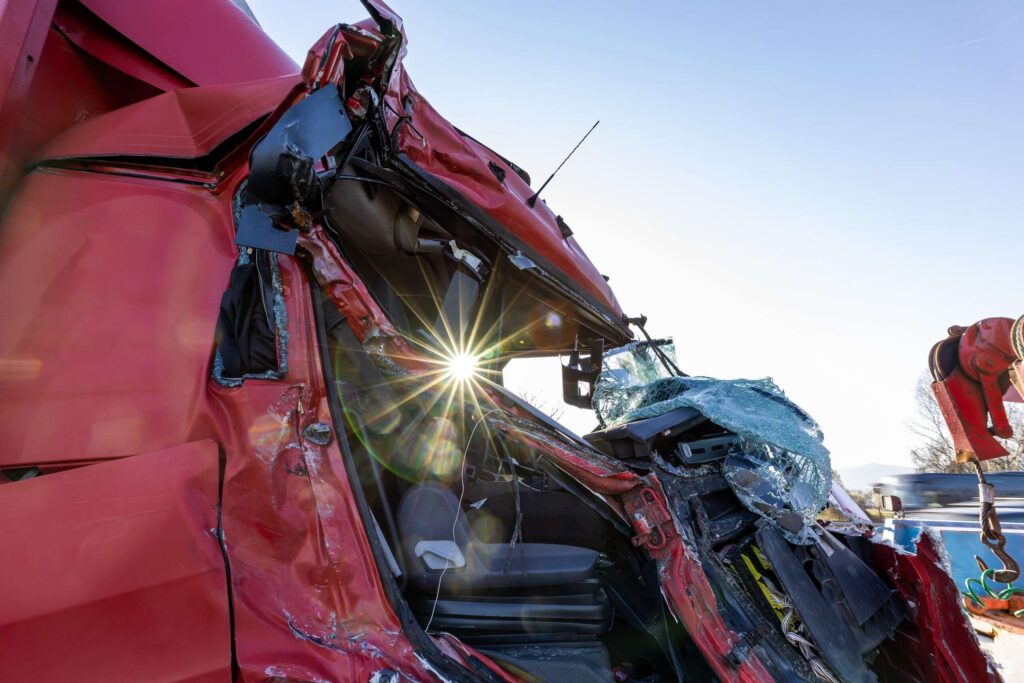
A fully loaded semi-truck can weigh roughly 20 times what an ordinary passenger car weighs. That difference is why the injuries sustained in truck accidents so often turn into claims measured in decades of care rather than a few months of treatment bills.
At the Law Offices of Mickey Fine, we have handled truck cases from both the insurance and the injury side for more than three decades. This post covers how the most serious injury categories change what a claim has to prove, what it costs, and who pays.
Key Takeaways:
- Truck accident injury claims tend to run larger than car accident claims because the same crash forces produce losses that last longer.
- Spinal cord injury, traumatic brain injury, and amputation claims are typically valued over a lifetime rather than over a treatment period.
- Some injuries are documented days after a crash, and the gap between the collision and the medical record becomes a contested issue in the claim.
- More than one party can share responsibility for a truck crash, and sorting out who is liable shapes the entire compensation process.
- California allows recovery of both economic and non-economic damages in a truck accident case, with no statutory cap on pain and suffering.
The Injuries That Show Up Immediately After a Truck Crash

Broken bones are the most visible injury in many truck crashes, and the forces involved often produce fractures far more complex than a typical car accident break. A femur, pelvis, or multiple rib fracture from a truck collision frequently requires surgical repair with plates, rods, or external fixation rather than a simple cast.
Internal bleeding is much harder to see and more dangerous. The seatbelt and steering wheel can cause blunt force trauma to the abdomen, even when the skin shows no obvious wound, and organs like the spleen or liver can tear or rupture from the impact. Emergency room staff typically run imaging on anyone involved in a truck crash for exactly this reason, since internal bleeding can be fatal if it goes undetected for even a few hours.
Whiplash and soft tissue injury still happen in truck crashes, but they tend to be more severe than the version most people associate with a minor rear-end collision. The sheer force behind a loaded truck can strain the neck and back well beyond what a passenger car impact typically produces.
Facial injuries and dental trauma also occur more frequently in truck crashes than many people expect, particularly when a driver or passenger makes hard contact with a steering wheel, dashboard, or window during the violent collision. These injuries are sometimes treated as minor compared to a broken femur, but reconstructive surgery, dental implants, and scarring can carry substantial costs of their own.
Spinal Cord Injuries and the Paralysis Risk Unique to Truck Crashes
Spinal cord injuries reach far into the future, because the consequences rarely resolve within a normal treatment window. The location and severity of the injury shape how the claim gets built, from the medical evidence gathered early to the life-care planning that follows, the process of projecting a person's future medical and support needs into a dollar figure. Having handled truck cases from the insurance side as well as the injury side, we know how carriers approach claims at this scale.
How a spinal cord injury changes what a claim is worth
Home modifications, mobility equipment, and attendant care are common needs after a spinal cord injury, and they follow a person well past the initial hospital stay. We build these claims around projected lifetime costs, not just the bills already in hand, since a settlement that only covers today's expenses can leave someone without support years down the road.
Why does proving liability matter so much in these cases
Establishing fault early matters more here than in most crash claims, since the projected cost of care is high enough that insurers look closely at causation. We start building the liability picture, covering driver conduct, company oversight, and road or equipment factors, from the earliest evidence available. The stronger the record, the stronger the claim's position in negotiation or at trial.
Traumatic Brain Injury: Why Truck Crash Forces Are Different
A traumatic brain injury happens when the head strikes an object or when the brain moves violently inside the skull, even without direct impact. The force of a truck collision can produce this kind of rapid deceleration injury even in occupants who never hit their head on anything inside the vehicle.
TBIs exist on a wide spectrum. A mild concussion may resolve within weeks with rest and monitoring, while a moderate or severe TBI can cause lasting changes to memory, mood, and the ability to work. Some symptoms, including headaches, sensitivity to light, and difficulty concentrating, do not appear until hours or days after the crash, which is why a normal-seeming CT scan at the emergency room does not always rule out a serious brain injury.
Family members are often the first to notice the more subtle signs of a TBI, since changes in personality, patience, or memory can be harder for the injured person to recognize in themselves. Documenting these changes early, even informally, tends to matter later if the case moves toward a settlement negotiation or trial.
Cognitive testing, neurological evaluation, and sometimes imaging beyond a standard emergency room CT scan help establish the extent of a brain injury that does not show up as a visible wound. Brain injury claims often need more supporting documentation than a broken-bone claim, since the damage is harder to see. Thorough documentation from the start is especially important in these cases.
What Are Crush Injuries and Amputations in Truck Accidents?
Crush injuries happen when part of the body becomes trapped between two surfaces under significant force, which is common in underride crashes and rollovers involving large trucks. Beyond the immediate tissue and bone damage, crush injuries carry a risk of compartment syndrome, a dangerous buildup of pressure inside a muscle compartment that can cut off blood flow if not treated quickly.
Amputations after a serious truck crash happen in two distinct ways. A traumatic amputation occurs at the moment of impact, when a limb is severed by the force of the crash or the wreckage itself. A surgical amputation happens afterward, when doctors determine that a crushed or severely damaged limb cannot be saved and must be removed to protect the patient's life.
Either way, amputation changes daily life permanently. Prosthetics, ongoing physical therapy, and adaptations to a home and vehicle become part of a recovery that never fully ends, and the psychological adjustment to limb loss is its own separate challenge on top of the physical one.
Phantom limb sensation, a well-documented experience where a person continues to feel pain or movement in a limb that is no longer there, adds another layer of difficulty to recovery that is easy to overlook from the outside. Occupational therapy focused on adapting daily tasks, along with mental health support, tends to make up a meaningful part of a full recovery plan alongside the physical rehabilitation.
Burns, Internal Organ Damage, and Injuries That Develop Later
Fuel-fed fires are a real risk in truck crashes, particularly rollovers, and burn injuries from these fires tend to be severe because they combine heat damage with the toxic effects of inhaling smoke and fumes. Deep burns often require skin grafting, and the scarring and nerve damage that follow can outlast the physical wound by years.
Internal organ damage beyond initial bleeding can include a punctured lung, kidney trauma, or damage to the bowel that does not always present with sharp early symptoms. Some of these injuries take days to fully declare themselves, which is one reason follow-up medical care matters even after an initial emergency room visit clears a person to go home.
Psychological injury belongs in the same conversation as physical damage. Anxiety around driving, sleep disruption, and heightened startle responses are common after a serious truck crash, and while these injuries do not show up on an X-ray, they are a real part of the harm a truck crash causes and can factor into a claim.
Scarring and disfigurement from burns or from the surgical repair of other injuries can carry their own compensable impact separate from the underlying medical treatment. A visible scar on the face or hands affects daily life in ways that go beyond physical function, and California Civil Jury Instructions (CACI) No. 3905A recognizes disfigurement as a distinct category of non-economic damages rather than folding it entirely into general pain and suffering.
Why Does Establishing Fault Matter So Much in These Cases?
A truck crash almost always involves more potential defendants than an ordinary car accident, which makes fault a more layered question from the start. Establishing liability is the first step to recovering compensation for these injuries, and that process usually starts with the driver's own conduct, from speeding and distraction to violations of federal hours-of-service rules, the regulations limiting how long a commercial driver can be on the road before resting.
The trucking company that employs the driver can also bear responsibility, particularly if it pushed an unrealistic schedule, skipped required maintenance, or hired a driver without properly checking a record of prior violations. In some cases, the company that loaded the cargo or the manufacturer of a defective truck part shares in the fault as well, depending on what caused the crash to happen.
California's pure comparative negligence rule, established in the 1975 case Li v. Yellow Cab Co., allows an injured person to recover damages even if they share some responsibility for the crash. A driver found 20 percent at fault for their own injuries can still recover 80 percent of their damages, which is a meaningfully different outcome than in states that cut off recovery entirely once a certain fault threshold is crossed.
Evidence in a truck case tends to disappear faster than in an ordinary car accident claim, since electronic logging device data, dash camera footage, and inspection records are only retained for a limited period before routine deletion. Sending a formal request to preserve this evidence early, called a spoliation letter, tells the trucking company and its insurer to keep the records instead of letting them be deleted on the usual schedule. Sending one can be the difference between having proof of what happened and being left to rely on conflicting witness accounts months later.
What Compensation Can You Recover for Catastrophic Injuries?
Economic damages cover the costs that come with a receipt or an invoice attached, including past and future medical bills, lost wages, and the cost of ongoing care like physical therapy or home health assistance. For a catastrophic injury like a spinal cord injury or severe TBI, these costs are often projected decades into the future using professional testimony about anticipated care needs.
Non-economic damages compensate for losses that do not come with a dollar figure already attached, such as pain and suffering, loss of enjoyment of life, and the impact an injury has on relationships with family. California places no cap on non-economic damages in a truck accident case. Unlike medical malpractice claims, which are subject to the limitations outlined in California Civil Code § 3333.2, general personal injury and wrongful death claims are not subject to a statutory cap on non-economic damages.
A catastrophic injury claim should also account for future losses that are easy to underestimate early on, including reduced earning capacity if the injury affects the kind of work a person can do going forward. Anyone working through a serious truck injury claim should learn what damages you may be entitled to recover before accepting an early settlement offer. Early offers are often set well below a case's eventual value, particularly in the weeks right after a crash when medical costs are still unclear.
FAQs: Truck Accident Injuries
These questions come up often once the basics of a truck injury case have already been covered above.
What happens if the trucking company disputes how the crash happened?
Disputes over fault are common in truck accident claims. Resolving them often comes down to the physical evidence, inspection records, and driver logs gathered soon after the crash. A dispute like this is exactly the kind of question worth raising with a Bakersfield truck accident lawyer directly.
Is a passenger in the truck itself entitled to compensation too?
Yes, in many cases. A passenger's right to recover depends on the circumstances of the crash and their relationship to the parties involved, so this is worth discussing directly rather than assuming coverage does not apply.
How does a jury value a permanent injury like paralysis or amputation?
Juries consider both the calculable economic costs and the harder-to-quantify non-economic impact, often guided by professional testimony about future medical needs, life expectancy, and the practical limitations the injury creates for work, relationships, and daily independence going forward.
What if the truck accident led to a family member's death?
California allows a wrongful death claim when a truck accident takes someone's life, and the people who can bring that claim depend on their relationship to the person who died. This is a separate legal process from a personal injury claim, and it is worth discussing directly with a Bakersfield truck accident lawyer.
How long do I have to file a claim for a truck accident injury in California?
California generally allows two years from the date of the crash to file a personal injury lawsuit, though certain circumstances, such as a government entity being involved, can shorten or extend that window, so it is worth confirming the applicable deadline early rather than assuming the standard rule applies.
Talk to a Bakersfield Truck Accident Attorney About Your Injuries
Catastrophic truck accident injuries change the shape of a person's life, and the financial reality that follows calls for a claim built around the full picture rather than a quick settlement. Our Bakersfield truck accident lawyers fight for full compensation for catastrophic injuries, and Mickey Fine personally reviews every case rather than routing it to an associate down the hall. His years of handling truck claims from the insurance defense side give the firm a working understanding of how carriers evaluate these cases.
Call the Law Offices of Mickey Fine at (661) 333-3333 for a free consultation. There is no fee unless we win, and the earlier we can start building the medical and liability picture, the stronger your case tends to be.