Every winter, a thick gray wall rolls across the Central Valley and swallows entire stretches of Highway 99 and I-5 within minutes. A tule fog truck accident is one of the most predictable dangers Kern County drivers face. What separates a routine foggy morning from a tule fog car accident, or something far larger, comes down to speed, following distance, and how much room a driver leaves to react.
At the Law Offices of Mickey Fine, we have spent more than 30 years on Kern County injury claims, and the same pattern repeats along this corridor every season. Fog drops visibility to a few dozen feet, one driver going too fast cannot stop, and a two-car collision becomes a 20 or 50-vehicle pileup. This post covers why these crashes happen and who can be held responsible.
Key Takeaways:
- Tule fog is one of the most serious Kern County winter driving hazards, forming when moisture from saturated soil rises and gets trapped by cool, stable air, often cutting visibility to a few dozen feet or less.
- Highway 99 and I-5 through Kern County have a documented history of large fog-related pileups, some involving dozens of vehicles and multiple semi trucks.
- Large trucks need far more distance to stop than passenger vehicles, which makes reduced visibility especially dangerous for multi-vehicle truck accidents.
- These chain-reaction crashes rank among the most severe types of truck accidents because each new collision adds force and confusion to an already dangerous scene.
- Liability in a fog pileup often depends on which drivers violated basic speed and following distance laws rather than blaming the fog itself.
What Is Tule Fog and Why Does Kern County Get So Much of It?
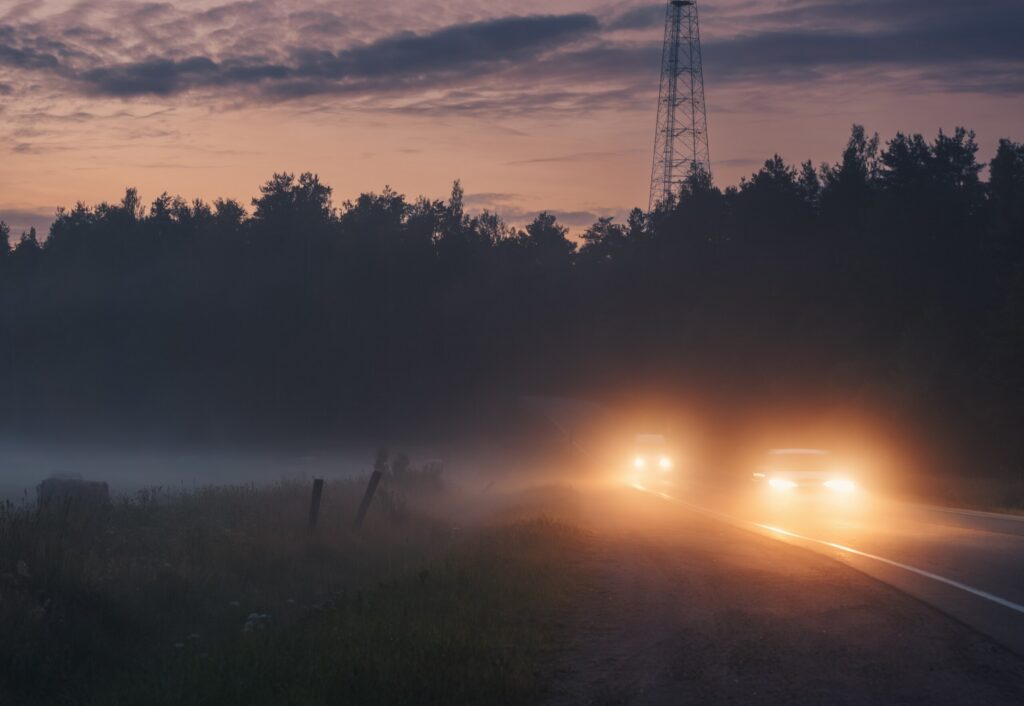
Tule fog forms when the ground releases moisture from recent rain into cool, still air, and the Central Valley's bowl-shaped geography traps that moisture instead of letting it disperse. Surrounding mountains hold the fog in place, sometimes for days, particularly in rural Kern County, where fewer buildings and less urban heat allow the fog to settle in and stay thick well into the morning.
The season typically runs from November through February, which lines up with the highest volume of holiday and winter freight traffic on Highway 99 and I-5.
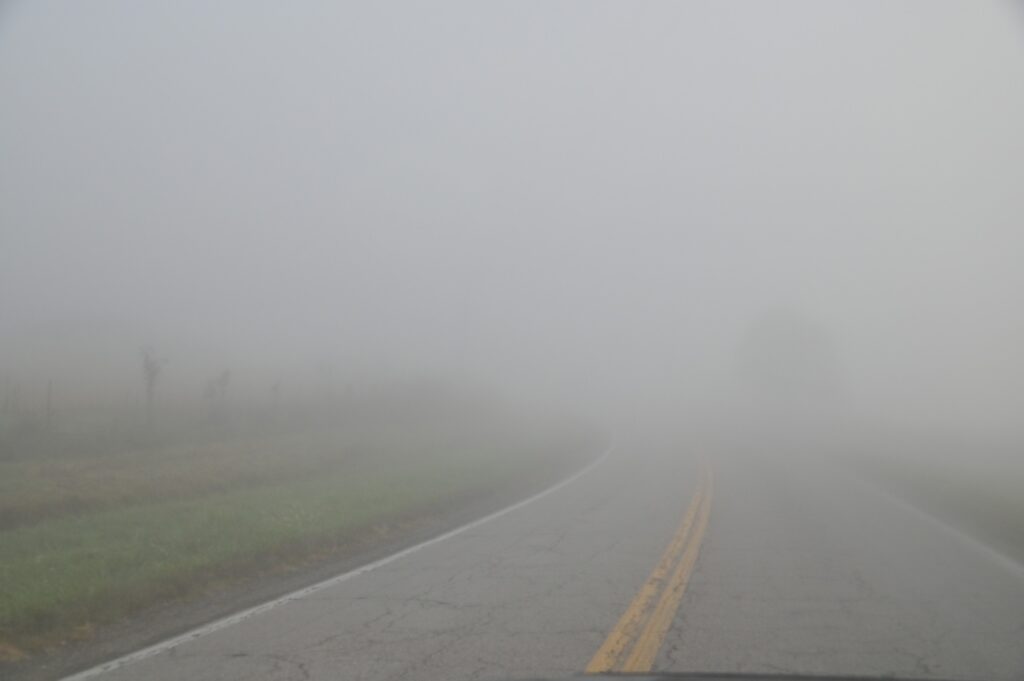
Visibility during a heavy tule fog event can drop to a few dozen feet, and sometimes closer to 10 feet in the worst pockets. That leaves almost no margin for a driver at highway speed to react to a stopped vehicle ahead.
The name itself comes from the tule grass that once grew in marshlands covering much of the Central Valley floor before large-scale agriculture reshaped the landscape. Unlike coastal fog, which tends to burn off within an hour of sunrise, tule fog can linger well into the late morning or even persist through an entire day, particularly in rural agricultural areas where there is little urban heat to help clear it.
Why Fog Turns Highway 99 and I-5 Into Danger Zones
Kern County sits where Highway 99 and I-5 both run through open agricultural land, which is exactly where tule fog forms most readily. Rural stretches near Delano, McFarland, and the Kern County line have produced some of the largest pileups in the Central Valley.
One chain-reaction crash on Highway 99 near the Tulare and Kern county line involved 59 vehicles and closed the highway in both directions for about six hours. Visibility at the time was roughly 100 to 200 feet, which is not unusual for a heavy fog morning on that stretch.
I-5 carries the same risk through Kern County, particularly along the rural stretch north of the Grapevine. A fog pileup there involved as many as 40 vehicles, 18 of them tractor-trailers, in what investigators described as three separate collisions close together. Visibility was down to about 10 feet when crews arrived.
These are not isolated events. The Central Valley's fog corridor has produced large-scale pileups on Highway 99 dating back decades, and the pattern repeats almost every winter somewhere along these two highways.
Just north of Kern County, Highway 99 through Fresno County has its own record of fog pileups, including one near-zero-visibility crash that pulled in 108 vehicles.
California Highway Patrol officers have pointed to driver behavior as the factor that decides how bad these crashes get. Drivers who slow down rarely contribute to a large pileup, while one or two drivers holding normal highway speed can set off a chain reaction that pulls in dozens of others.
How Poor Visibility Contributes to Truck Crashes
Poor visibility is a leading contributing factor in multi-vehicle truck accidents, and the physics behind why is straightforward. A loaded semi truck traveling at highway speed needs significantly more distance to come to a complete stop than a passenger car, often several hundred feet longer, depending on the truck's weight, road surface, and the driver's reaction time.
When fog cuts visibility to a few dozen feet, a truck driver may not see a slowdown until it is already too close to stop safely, no matter how attentive that driver is.
California Vehicle Code Section 24400 requires headlights in inclement weather, which the statute defines as any condition preventing a driver from clearly seeing a person or vehicle 1,000 feet away, or any condition requiring continuous windshield wiper use because of fog or mist. Low beams work better than high beams in fog because high beams reflect off the moisture and reduce visibility instead of improving it.
The following distance becomes the single most important variable in fog. A driver who maintains a safe gap has time to react to whatever appears out of the mist ahead, while a driver following too closely, especially at highway speed, removes almost all of that margin. This is exactly the gap that turns a single slowdown into the first collision of a much larger pileup.
Weight adds another layer of difficulty to the problem, specific to trucks. A fully loaded semi truck can weigh more than 20 times what an ordinary passenger car weighs, and that extra mass means far more momentum has to be absorbed before the vehicle comes to a complete stop, even with functioning brakes and an alert driver behind the wheel.
Why Are Chain-Reaction Pileups So Dangerous?
Chain-reaction pileups are among the most severe types of truck accidents because of how quickly they compound. The first collision in dense fog often happens with little or no warning to the vehicles approaching from behind, since drivers cannot see far enough ahead to know a crash has already occurred until they are nearly on top of it.
Each vehicle that arrives afterward adds new force to an already chaotic scene, and a loaded truck arriving at highway speed into the back of a pileup can push smaller vehicles into each other or crush them between other trucks. Some of the largest fog pileups in the Central Valley have involved 40, 50, or more vehicles colliding within minutes of each other, largely because each new arrival has almost no time to process what is happening ahead before becoming part of the wreckage.
First responders face their own version of this danger, since they must navigate the same zero-visibility conditions that caused the crash to reach the people trapped inside it. This is part of why officials in past incidents have specifically urged drivers to avoid travel entirely during the heaviest fog rather than attempting to push through at a slightly reduced speed.
Who Can Be Held Liable in a Fog-Related Pileup?
Fog is a condition, not an excuse, and California Vehicle Code § 22350 requires drivers to operate at a speed that is reasonable and prudent for existing conditions, including visibility limitations caused by fog. A driver who causes a collision by following too closely or driving faster than conditions allow can be held responsible for that crash even though the fog was a contributing factor, since the basic speed law requires drivers to slow down for weather rather than maintain the posted limit regardless of visibility.
Sorting out fault in a pileup involving a dozen or more vehicles is far more complicated than sorting out a typical two-car crash. Investigators often reconstruct the sequence of individual collisions to determine which driver's actions actually caused which impact, since a vehicle struck from behind and pushed into the car ahead of it may not be at fault for that second collision.
Trucking companies can also share responsibility. If a carrier's scheduling or dispatch practices left a driver without a realistic option to stop and wait out a fog event, that becomes part of the liability picture alongside the driver's own decisions.
California's comparative negligence rule allows fault to be divided among several drivers and companies at once. In a pileup, that often means more than one party contributes to an injured person's total recovery.
How to Protect Yourself When Driving Through Tule Fog
Slowing down well below the posted speed limit is the single most effective step a driver can take in heavy fog, since speed is consistently the factor most tied to fog-related crashes according to California Highway Patrol officials. Increasing following distance matters just as much, since it gives a driver more time to react to whatever appears out of the mist ahead.
Low beam headlights cut through fog better than high beams, which reflect and make visibility worse rather than better. Drivers should avoid using parking lights or fog lights as a substitute for headlights, and should not assume automatic headlights have engaged in daytime fog. County officials responding to Central Valley pileups have specifically urged drivers not to rely on automatic headlights during dense fog.
If fog becomes too thick to see safely, pulling off the roadway entirely and waiting it out is safer than continuing to drive, even slowly, through a zero-visibility stretch. When this is not possible, staying alert for brake lights and unusual sounds ahead, rather than relying on sight alone, can provide a few extra seconds of warning before a collision, which is sometimes the difference between avoiding a crash and becoming part of one.
FAQs: Tule Fog Truck Accidents
Why does Kern County seem to have more fog pileups than other parts of California?
Kern County sits along two of the state's busiest freight corridors, Highway 99 and I-5, and both pass through open agricultural land where the Central Valley's trapped, bowl-shaped geography allows tule fog to form and linger for extended periods each winter.
Can a trucking company be liable if its driver was following the speed limit?
Yes, potentially. The posted speed limit is a maximum under ideal conditions, not a promise of safety at that speed, so a driver traveling at the limit in dense fog can still be found to have driven too fast for the actual visibility.
How is fault determined when dozens of vehicles are involved in one pileup?
Investigators typically work to carefully reconstruct the sequence of individual collisions using physical evidence, witness accounts, damage patterns, and sometimes electronic data from trucks involved, since a large pileup is usually made up of several distinct impacts happening in sequence rather than one single event.
Is the tule fog season the same every year?
The season generally runs from November through February, though the exact timing and severity shift from year to year depending on rainfall and weather patterns, so the risk window is not identical every winter.
What should I do if I am involved in a fog pileup?
Turn on hazard lights if it is safe to do so, stay inside the vehicle if it is in a dangerous position on the roadway, and call 911 as soon as possible, since additional vehicles may still be approaching the crash scene.
Does it matter if I was hit from behind rather than causing the crash myself?
Yes. A driver struck from behind and pushed into another vehicle is often not at fault for that resulting collision, which is part of why a full investigation into the sequence of impacts matters in a multi-vehicle case.
If You Were Hurt in a Fog-Related Truck Accident
Tule fog pileups happen fast, and the aftermath is often chaotic, with multiple vehicles, multiple insurance companies, and a sequence of impacts that can be difficult to untangle without a thorough investigation. If you were hurt in a fog-related truck accident, our Bakersfield truck accident lawyers can help sort out what actually happened and who should be held responsible for it, whether that means one trucking company or several parties at once.
Call the Law Offices of Mickey Fine at (661) 333-3333 for a free consultation. Mickey Fine personally reviews every case rather than routing it to an associate, and you pay nothing unless we recover compensation for you.