A fender bender at Valley Plaza or the Marketplace rarely feels like a real accident. There is no highway, no skid marks, no high-speed impact. But when two bumpers meet in a parking row on California Avenue, the question of who is at fault in a parking lot accident gets complicated fast.
Parking lots feel informal, so people assume the rules are too. They aren't. At the Law Offices of Mickey Fine, we handle these disputes for Kern County drivers, and the one who backs out without looking is not automatically the only one on the hook.
Key Takeaways:
- Parking lot accidents in California follow standard negligence principles, even though most traffic laws don't automatically apply on private property
- Fault often comes down to right-of-way in through lanes versus feeder lanes, not simply who was moving
- California is a pure comparative fault state, so a driver who is partly responsible can still recover a reduced amount
- Security camera footage and witness statements carry more weight in parking lots than on public roads because there are fewer independent points of reference
- Drivers involved in a parking lot collision have specific legal duties under state law, even for minor damage
Does California Traffic Law Apply Inside a Parking Lot?
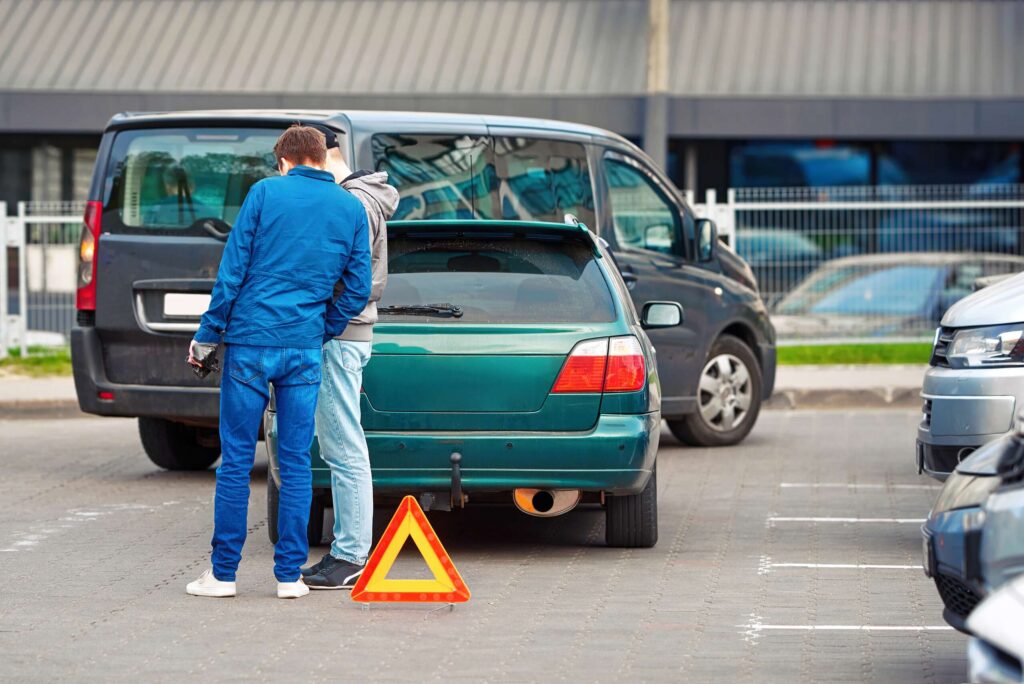
Mostly, no. The Vehicle Code's rules of the road apply only on highways, a limit set by Vehicle Code Section 21001, and Vehicle Code Section 360 defines a highway as a publicly maintained road open to public travel. A privately owned shopping center lot generally isn't one.
Under Vehicle Code Section 21107.8, a city or county can extend only three of those rules to a private lot: the basic speed law, reckless driving, and speed contests. That extension works only if the owner posts a notice at each entrance. Other parts of the Vehicle Code, including a driver's duties after a crash, still apply in a parking lot.
That gap doesn't mean drivers are off the hook. Ordinary negligence law fills the space. Under Civil Code Section 1714, everyone in California owes a duty to use reasonable care to avoid injuring others, and that duty doesn't stop at the edge of a highway.
Speeding through a Stockdale Highway shopping center, rolling past a painted stop sign, or backing out without checking a mirror can still make a driver responsible. The claim just runs on general negligence principles instead of a specific traffic code section. Fault in a parking lot accident is decided the way it is anywhere else, by asking who failed to act with reasonable care.
The line between a public road and a private lot comes up in nearly every parking lot claim we review. Section 21107.8 does not cover stop sign violations, so a stop sign in a shopping center works more like a safety expectation than a citable traffic law. Ignoring it is still strong evidence of carelessness once a negligence claim is filed.
Where Fault Gets Decided: Through Lanes, Feeder Lanes, and Blind Spots
Most Bakersfield parking lots have a mix of two lane types. Through lanes run along the front of a building or down the center of the lot, carrying continuous traffic. Feeder lanes branch off between rows of parked cars, feeding vehicles toward those through lanes.
Here's the general rule insurance adjusters apply when they sort out a parking lot claim: a car in a through lane usually has the right-of-way over a car pulling out of a feeder lane or a parking space. A driver entering the through lane is expected to stop, look, and yield before merging in. When they don't, and a collision happens, that driver typically bears most or all of the fault.
It's not automatic, though. If the through-lane driver was speeding, distracted, or clearly visible and ignored, fault can shift or split. This is exactly the kind of nuance that turns a simple fender bender into a contested claim.
Diagonal Rows, Perpendicular Spaces, and Why Layout Matters
Not every Bakersfield lot is built the same way, and the layout changes how fault gets analyzed. Diagonal parking, common at older strip centers along Chester Avenue, generally directs traffic in one expected flow, so a driver going the wrong way against that flow starts the fault conversation already behind.
Perpendicular spaces in larger lots, like those outside big-box stores near the 99, create more blind intersections where two feeder lanes cross without any signage at all. In those unmarked crossings, adjusters often apply something close to the right-hand rule used at four-way stops: the vehicle approaching from the right generally has the edge, though this is a guideline rather than a binding law inside a private lot.
How Do Insurance Adjusters Determine Fault in a Parking Lot Crash?
Because parking lots aren't blanketed in the same traffic laws as public streets, insurance adjusters use specific factors to determine fault, and they lean heavily on physical evidence since there's rarely a police accident report to anchor the file.
Adjusters typically look closely at:
- The point of impact on both vehicles, which often shows who was moving into whose path
- Posted signage, painted arrows, and stop signs within the lot itself
- Store security camera footage, which many Bakersfield retailers retain for only a short window
- Independent witness accounts from other shoppers or employees
- Whether either driver was backing out, since backing drivers carry a heavier burden to prove they checked their surroundings
A driver hit while backing out of a space at Rancho San Miguel or a busy big-box lot off Rosedale Highway on a Saturday afternoon is not automatically at fault just because their car was in reverse. If the other driver was speeding through the row or cutting across empty spaces diagonally, responsibility can land mostly on them instead.
Low-Speed Collisions Follow Similar Fault Rules
Sideswipes between parked and moving cars, or two vehicles clipping mirrors as they pass in a narrow row, rarely involve much speed. Low-speed collisions like sideswipes follow similar fault rules to the through-lane and feeder-lane analysis above: the question is which driver strayed from their expected path, not how hard the impact was.
Two cars backing out at the same time is a common Bakersfield scenario, and it often results in shared fault. Both drivers have a duty to look before reversing, so when neither one checks carefully enough, an adjuster may split responsibility 50-50 or close to it.
California's Comparative Fault Rule Protects Partly-At-Fault Drivers
California follows a pure comparative fault system. If a driver is found 20 percent responsible for a parking lot crash, their compensation is reduced by 20 percent, not eliminated. This traces back to the California Supreme Court's decision in Li v. Yellow Cab, which replaced the old rule that any fault at all barred recovery.
This matters enormously in parking lot cases, where fault is rarely 100 percent on one side. A driver who was hit while backing out, but who also backed out a bit too fast, can still pursue a claim. The percentage assigned to each side simply adjusts the final dollar amount recovered.
What Should You Do After a Parking Lot Accident in Bakersfield?
Under Vehicle Code Section 20002, any driver involved in an accident causing property damage, including a parking lot fender bender, must stop and exchange information with the other party. If the other vehicle is unattended, the law requires leaving a written note with your name, address, and the circumstances in a conspicuous spot on that vehicle. It also requires notifying the local police department, or the California Highway Patrol in unincorporated Kern County, without unnecessary delay.
Separately, Vehicle Code Section 16000 requires a report to the DMV on Form SR-1, its traffic accident report, within 10 days when a crash causes injury, death, or more than $1,000 in damage to any one person's property. That duty covers qualifying off-highway crashes, so a parking lot collision is not exempt. Missing the deadline can put a driver's license at risk.
Beyond that legal minimum, a few practical steps make the difference between a claim that gets paid quickly and one that drags on for months over a fault dispute:
- Take photos of both vehicles, the point of impact, and the surrounding lane markings or signage before anyone moves
- Ask nearby employees or shoppers if they saw what happened, and get contact information while they're still there
- Request that the store preserve security footage in writing, since many systems overwrite recordings within days
- Report the collision to local police, which the law requires when you leave a note on an unattended vehicle and which is worth doing for documentation either way
Kern County retail centers vary widely in how long they keep camera footage, and a delayed request can mean the difference between having proof and having none.
How Long Do You Have to File a Claim?
Two deadlines matter after a parking lot crash. Code of Civil Procedure Section 335.1 gives injured drivers two years from the date of the crash to file a personal injury lawsuit, and Code of Civil Procedure Section 338 allows three years for a claim covering vehicle damage alone. Shorter deadlines can apply in some situations, including claims against a public entity, so confirm your own with an attorney.
Those windows sound distant right after a minor parking lot accident. Evidence disappears much faster, particularly security footage and the memories of witnesses who were only passing through.
If a parking lot collision led to a documented physical injury, medical bills and lost wages become part of the claim. California law also allows recovery for pain and suffering, but only where it is connected to that physical injury. Emotional distress on its own, with no accompanying physical harm, does not support a standard injury claim of this kind.
Why Bakersfield Drivers Call Mickey Fine After a Parking Lot Crash
Mickey Fine spent years on the other side of these disputes as an insurance defense lawyer, so we know how a carrier evaluates a low-speed parking lot claim and what evidence moves it. With more than 30 years of handling Kern County injury claims, we build every file to hold up whether it settles or goes before a jury in Kern County Superior Court. That experience shapes how we work a claim from the first phone call.
- Attorney Mickey Fine handles every case personally, and we never pass a file to a rotating team of associates
- We work on a contingency fee, which means our fee comes out of the recovery rather than an hourly bill, so there is no upfront cost and nothing owed unless the case results in a recovery
- Our consultations are free, and we respond within 24 hours of a call
- We can connect injured clients with medical providers who treat now and wait for payment until the case resolves
Parking lot disputes often come down to which side gathered better evidence faster, and that's where early legal help changes the outcome. Because these claims rarely come with a police-issued fault determination, the file has to be built from footage requests, witness statements, and repair estimates gathered within days, not weeks, of the crash. Waiting even a short time can mean losing access to the one clear piece of video that would have settled the fault question outright.
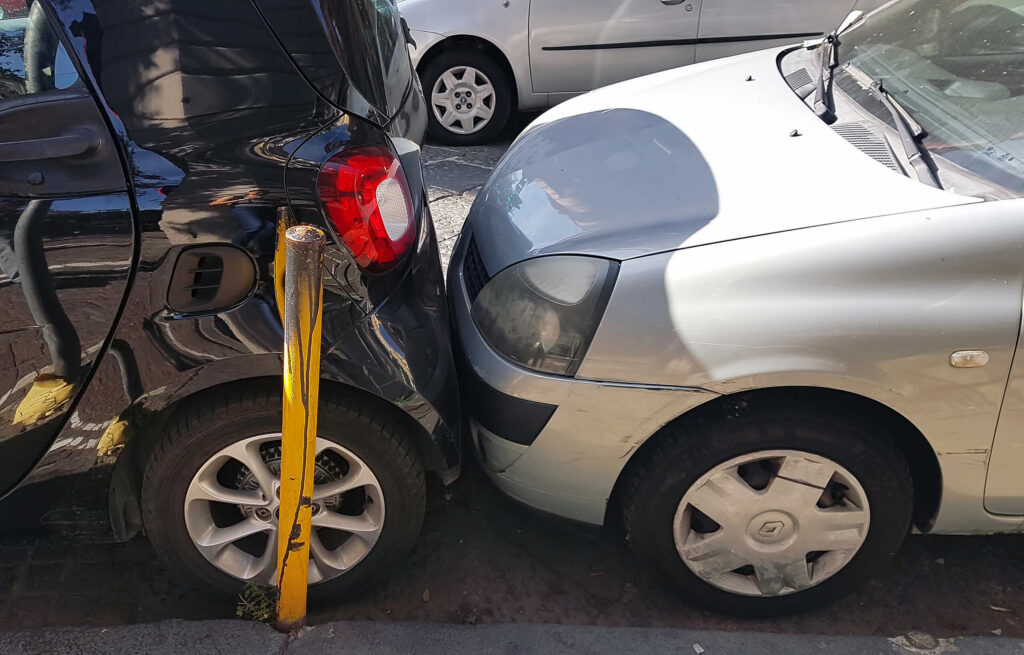
FAQs: Who Is at Fault in a Parking Lot Accident
Do I need to call the police for a minor parking lot fender bender?
Sometimes. If you hit an unattended vehicle and leave a note, Vehicle Code Section 20002 also requires notifying police without unnecessary delay. When both drivers are present and exchange information, no call is required, though calling is still worth doing because Bakersfield Police and the Kern County Sheriff's Office will sometimes log an informal record that helps if the other driver's story changes later.
Does my auto insurance treat a parking lot accident differently from a street accident?
No. Collision and liability coverage apply the same way regardless of where the crash happened, as long as it involved a vehicle in operation. The claims process and fault investigation are what differ, since there's no officer-issued citation to lean on.
What if there were no painted lines or arrows in the parking lot at all?
Missing markings do not change the fault analysis. Adjusters apply the same logic they use in a marked lot, based on which driver was traveling a natural through path versus which one was entering or crossing that path. Worn-off or absent markings are common in older Bakersfield strip centers, which makes witness accounts and camera footage matter more.
Can a store be held responsible for an accident in its own parking lot?
A store can be held responsible, but only when something about the property itself contributed to the crash. A sightline blocked by overgrown landscaping, a collapsed lane barrier, or lighting too poor to see a moving car can each support a premises liability claim, which is a claim that the property owner failed to keep the lot reasonably safe. Most parking lot collisions still come down to a dispute between the two drivers.
What if the other driver was on their phone when they hit me?
Distraction doesn't change the legal analysis much on private property, since texting laws are tied to public roadway enforcement. It can still support a negligence claim, especially if a witness or footage confirms it, because it shows a failure to exercise reasonable care.
Is it worth pursuing a claim if the damage was only a few hundred dollars?
Often, yes, if anyone was hurt. Vehicle damage alone might not justify legal help, but a documented physical injury changes the calculation. It is worth a conversation before accepting a quick payout that closes the file.
How is fault different at a large lot like Valley Plaza compared to a small strip mall?
Larger lots tend to have more through-lane and feeder-lane structure, which makes right-of-way analysis clearer. Smaller lots with tighter rows and less defined lanes often come down more heavily on witness accounts and camera footage, since the layout itself offers fewer clues.
Talk to a Bakersfield Car Accident Lawyer About Your Parking Lot Claim
Parking lot accidents get dismissed as minor more often than they should be, and a claim that settles quickly often settles for less than the damage actually costs. If you were hurt or your vehicle was damaged in a Kern County parking lot, our Bakersfield car accident lawyers can help you determine fault and file your claim before evidence disappears.
Call the Law Offices of Mickey Fine at (661) 333-3333 today for a free, no-obligation consultation about your specific accident. Attorney Mickey Fine reviews every case personally, and you pay nothing unless we recover compensation for you.