
In Bakersfield, the first version of a pedestrian crash story often blames the person who was walking. A driver says you appeared out of nowhere, an officer notes you crossed outside the lines, and suddenly an insurer treats your injuries as your own mistake. A Bakersfield pedestrian accident lawyer knows that first version is rarely the full one, and that the evidence to challenge it starts disappearing within days.
At The Law Offices of Mickey Fine, we dig into what actually happened at that curb, that crosswalk, or that parking lot. Mickey spent years building defense files for insurers before he switched sides. Call (661) 333-3333 for a free consultation about your crash.
Póngase en contacto con la oficina legal de Mickey Fine hoy para ver cómo podemos ayudar.
Does a Police Report Blaming You End Your Pedestrian Case?
No, a police report that faults you does not end your case. Under Vehicle Code Section 20013, courts cannot treat the written collision report itself as evidence at trial, and the officer usually arrived after the impact, piecing events together from whoever could still talk.
That matters because a report's conclusions often rest on the driver's account while the injured person sits in an ambulance on the way to Kern Medical. Your own memory of the crossing carries real weight too.
California also follows a pure comparative fault system, created by the state supreme court, which divides responsibility by percentage instead of all or nothing. Even if a jury finds you partly responsible, you can still recover the share of your losses caused by the driver. A pedestrian accident attorney in Bakersfield builds the case to shrink that percentage, using evidence the report never considered.
Officers also make mistakes under pressure, from mislabeling which lane a vehicle occupied to recording the wrong signal phase. When we find those errors, we can often correct the record through a supplemental report or witness declarations.
Does Crossing Mid-Block Mean the Crash Was Your Fault?
Crossing mid-block does not automatically make a crash your fault, even though many people hit by a car walking in Bakersfield outside a crosswalk assume they have no claim. California law paints a more balanced picture of who owes what:
- Crosswalks, marked or not: Vehicle Code Section 21950 requires drivers to yield to pedestrians in any crosswalk, including the unpainted ones that legally exist at most intersections.
- Crossing between intersections: Section 21954 asks pedestrians outside a crosswalk to yield, yet it still requires drivers to use due care for anyone on the road.
- The Freedom to Walk Act: Since 2023, Section 21955 bars officers from citing someone for crossing mid-block unless a reasonably careful person would see an immediate danger of collision.
- Roads outside town centers: Section 21956 directs pedestrians walking on a roadway outside a business or residence district to stay close to the left edge, facing traffic.
That last rule comes up on rural stretches around Lamont, Oildale, and the edges of east Bakersfield, where sidewalks can vanish for blocks at a time. A driver who hits someone walking along a road shoulder still owed that person reasonable care, regardless of where the pavement ended.
Why Do So Many People Get Hit by a Car Walking in Bakersfield After Dark?
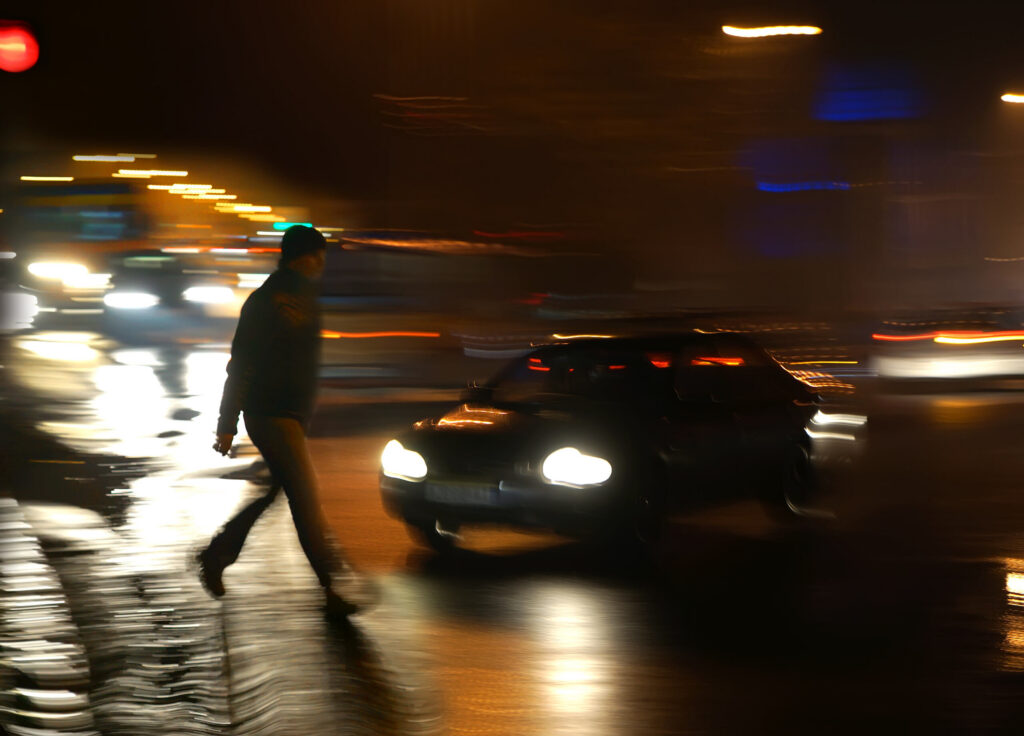
Most serious pedestrian crashes here happen at night, when speed, poor lighting, and impairment overlap. Smart Growth America's Dangerous by Design report ranked the Bakersfield-Delano metro third in the country for pedestrian deaths, at about five per 100,000 residents.
Wide arterials like Union Avenue, South H Street near White Lane, Stine Road, and Weedpatch Highway combine fast traffic with long gaps between signals, and that pairing leaves little margin for anyone on foot.
After dark, insurers lean hard on one argument: you wore dark clothing, so the driver never had a chance. We answer that with headlight range, posted speeds, and the stopping distance a careful driver would have needed. When the math shows the driver would have seen you in time at a lawful speed, the clothing argument loses much of its force.
Streetlight outages reported to the city before the crash can strengthen that point further. Learn your legal options for filing a personal injury lawsuit if a distracted driver hit you as a pedestrian.
How We Rebuild a Crossing That Lasted Three Seconds
A pedestrian crash often unfolds in less time than it takes to read this sentence, which means the proof has to be reconstructed piece by piece. Our reconstruction work typically draws on:
- Signal timing records from the City of Bakersfield showing how long the walk phase lasted
- Security footage from gas stations, taquerias, and storefronts along the route
- The vehicle's event data recorder, which can capture speed and braking in the seconds before impact
- Sight-line measurements and nighttime lighting readings taken at the same hour as the crash
- Phone records when evidence suggests the driver was texting or scrolling
Business cameras on busy corridors often record over themselves within days, so the canvass starts immediately. Pulling that footage early can turn a disputed crossing into one with a clear answer.
We also factor in conditions that shaped what each person could see, including sun glare at dawn and dusk along east-west streets like Ming Avenue and construction zones.
Mickey prepares these files the way he once watched defense firms prepare them, anticipating every argument before it arrives. That trial-ready groundwork gives any settlement discussion a firmer footing.
Parking Lots Follow Different Rules Than City Streets
A surprising number of pedestrians get hurt without ever stepping into traffic. Shopping centers like Valley Plaza and The Marketplace, grocery store lots, and hospital garages see steady foot traffic mixed with drivers hunting for spaces or backing out without a second look.
Crosswalk statutes largely govern public roads, so private lot cases lean on the general negligence rule in Civil Code Section 1714. That rule holds every person responsible for harm caused by a lack of ordinary care, which covers a driver reversing blindly out of a stall.
The property owner may share responsibility too. Burned-out lights, confusing traffic flow, or missing stop signs inside a lot can all contribute, and the owner's commercial insurance may provide coverage the driver alone cannot.
Parking lot drivers also tend to underestimate their own speed, since they feel shielded from real traffic. Store surveillance cameras often capture these crashes clearly, and a prompt preservation request can keep that footage from being erased.
What Happens if the Driver Never Stops?
If the driver flees, your own auto insurance may still pay for your injuries through uninsured motorist coverage. California treats leaving an injury crash as a crime under Vehicle Code Section 20001, but a criminal case does nothing to cover your hospital bills.
Uninsured motorist coverage under Insurance Code Section 11580.2 can apply even when you were walking rather than driving. The statute carries strict conditions for hit-and-run claims, including physical contact with the vehicle and a report to police within 24 hours, so timing matters from the first day.
Hit-and-run survivors may also qualify for help through the California Victim Compensation Board, a state program that can cover certain medical costs and lost income for crime victims. We coordinate these sources so one does not cancel out another.
Some auto policies also include medical payments coverage, often called MedPay, which can pay treatment bills regardless of fault. Many people never realize their own policy follows them onto the sidewalk, so we review every policy in your household before assuming coverage is gone.
Can the City or County Share Responsibility for a Pedestrian Crash?
Yes, a public agency can share responsibility when a dangerous road condition helped cause the crash. Government Code Section 835 allows claims against public entities for dangerous conditions of property they own or control, such as a signal that never gives walkers enough time or a crosswalk with no lighting.
These claims run on a short clock. Government Code Section 911.2 generally requires a written claim within six months of the injury, a deadline that applies whether the road belongs to the City of Bakersfield, Kern County, or Caltrans.
Proving a dangerous condition requires showing the agency knew or should have known about the problem and had time to fix it. Prior complaints, earlier crashes at the same spot, and maintenance logs obtained through public records requests often supply that proof.
Claims against private drivers follow a longer timeline, with most lawsuits due within two years under Code of Civil Procedure Section 335.1. A Bakersfield pedestrian accident attorney tracks both deadlines at once, since missing the shorter one can remove an entire source of recovery.
When the Person Hurt Is a Child, or the Person Lost Is a Parent
Children face the highest risk near schools, parks, and apartment complexes, where they dart between parked cars or misjudge how fast a vehicle is moving. Because California expects less caution from a young child than from an adult, a driver in a school zone or neighborhood carries a heavier practical burden to watch for them.
A parent or guardian brings the claim on the child's behalf. A court must approve any settlement for a minor under Probate Code Section 3500, and the money often goes into a blocked account or a structured settlement, which pays out in scheduled installments, until the child turns 18.
The standard two-year filing period for a child's injury claim is paused until adulthood under Code of Civil Procedure Section 352, although public-entity claims still follow their own shorter rules. Waiting carries a cost, since witnesses move and video disappears long before a child grows up.
When a crash takes a life, certain family members may pursue a wrongful death claim under Code of Civil Procedure Section 377.60. These claims can recover lost financial support, funeral costs, and the loss of a parent's or spouse's love, guidance, and companionship. A pedestrian injury attorney in Kern County handling these cases must balance legal precision with patience for a family that is grieving.
Opiniones de nuestros clientes
What a Pedestrian Injury Lawyer in Kern County Counts as Damages
Pedestrians hit by a car or pickup often face serious, lasting injuries, and the costs rarely stop at the emergency room.
A full damages claim typically accounts for:
- Hospital stays, surgeries, and follow-up care
- Rehabilitation, therapy, and medical equipment
- Lost income, including reduced earning capacity for workers in agriculture, oil, and warehouse jobs that demand full mobility
- Pain, lost independence, and emotional distress that come with those physical injuries
A hospital lien is a legal claim by the hospital to be repaid out of your settlement, and Civil Code Section 3045.1 allows hospitals to place one on your recovery. We account for those claims when valuing a case and push to reduce them where the law allows.
A Pedestrian Accident Attorney in Bakersfield Who Used to Defend Insurers
Knowing how the other side thinks changes how a case gets built. Mickey Fine has practiced law for more than 30 years, including years defending insurance companies, and that history shapes every file we open.
- Defense-side insight: Mickey recognizes the arguments insurers commonly raise in pedestrian claims, often before they surface.
- Personal attention: You work directly with Mickey from the first meeting through resolution, not a rotating list of case managers.
- Care without upfront costs: We connect clients with medical providers and handle cases on contingency, so you pay no attorney fees unless we recover money for you.
- Downtown presence: Our office sits on Truxtun Avenue, a short walk from the Kern County Superior Court.
- Fast response: We respond to new inquiries within 24 hours.
People hurt on foot face severe injuries and skeptical insurers at the same time. They need someone who sees the person behind the medical chart and stays ready to take it to trial if a fair offer never comes. Call (661) 333-3333 to talk with Mickey about what happened.
FAQs: Bakersfield Pedestrian Accident Lawyer
People hurt on foot in Bakersfield and across Kern County often ask these questions.
Does California law treat me as a pedestrian if I use a wheelchair?
California law treats a wheelchair user as a pedestrian. Vehicle Code Section 467 defines a pedestrian to include anyone using a wheelchair, whether manual or motorized, along with people on skateboards or other non-bicycle devices powered by their own muscles. That definition gives wheelchair users the same crosswalk protections as someone walking.
What if I was hit while walking as part of my job?
A pedestrian hit while working may have two claims running side by side. Workers' compensation typically covers medical care and part of your wages regardless of fault, while a separate claim against the at-fault driver can reach losses workers' compensation does not pay, such as pain and suffering.
Will Medi-Cal want to be repaid from my settlement?
Medi-Cal usually does want to be repaid from a pedestrian settlement. Welfare and Institutions Code Section 14124.71 gives the state a right to recover what Medi-Cal paid for crash-related treatment, and you must resolve that claim before settlement funds go out. The amount can often be reduced to reflect attorney fees and costs.
The driver who hit me was using someone else's car. Can I claim against the owner?
A claim against the vehicle's owner is often possible. California holds vehicle owners liable when they give someone permission to drive, though Vehicle Code Section 17151 caps that owner liability at $15,000 per person for injuries. The driver's own policy and the owner's insurance may both come into play.
What if a driver hit me on the sidewalk while pulling out of a driveway?
Drivers crossing a sidewalk must yield to anyone walking on it under Vehicle Code Section 21952. Driveway crashes frequently involve drivers watching for cars in the street instead of people on the sidewalk, which makes this rule especially important.
What if the driver who hit me was making deliveries for work?
Employers may bear responsibility for crashes their employees cause while on the job. Civil Code Section 2338 makes a business answerable for the negligence of its agents acting within the scope of their work, and commercial policies often carry higher limits than personal ones. Delivery vans and box trucks moving between warehouses around Shafter and east Bakersfield make this question increasingly common.
Do I have to give a statement to the driver's insurance company?
You have no legal duty to give a recorded statement to the other driver's insurer. Your own policy may require cooperation with your insurer, which is a separate obligation. Anything you say to the at-fault driver's carrier can shape how it values your claim, so many people choose to let their attorney handle that contact.
Discover key traffic laws every walker should know to stay safe and protect their rights after a pedestrian crash.
Talk With a Bakersfield Pedestrian Accident Lawyer on Truxtun Avenue
The moments before a pedestrian crash last seconds, but the questions they leave behind can linger for years. Waiting while an insurer decides what your injuries are worth rarely works in your favor.
Bring your questions to a Bakersfield pedestrian accident lawyer who has sat on both sides of these cases. The Law Offices of Mickey Fine works with injured walkers and grieving families throughout Kern County. Call (661) 333-3333 for a free consultation or visit our office at 930 Truxtun Avenue, Suite 110, to talk through what comes next.